
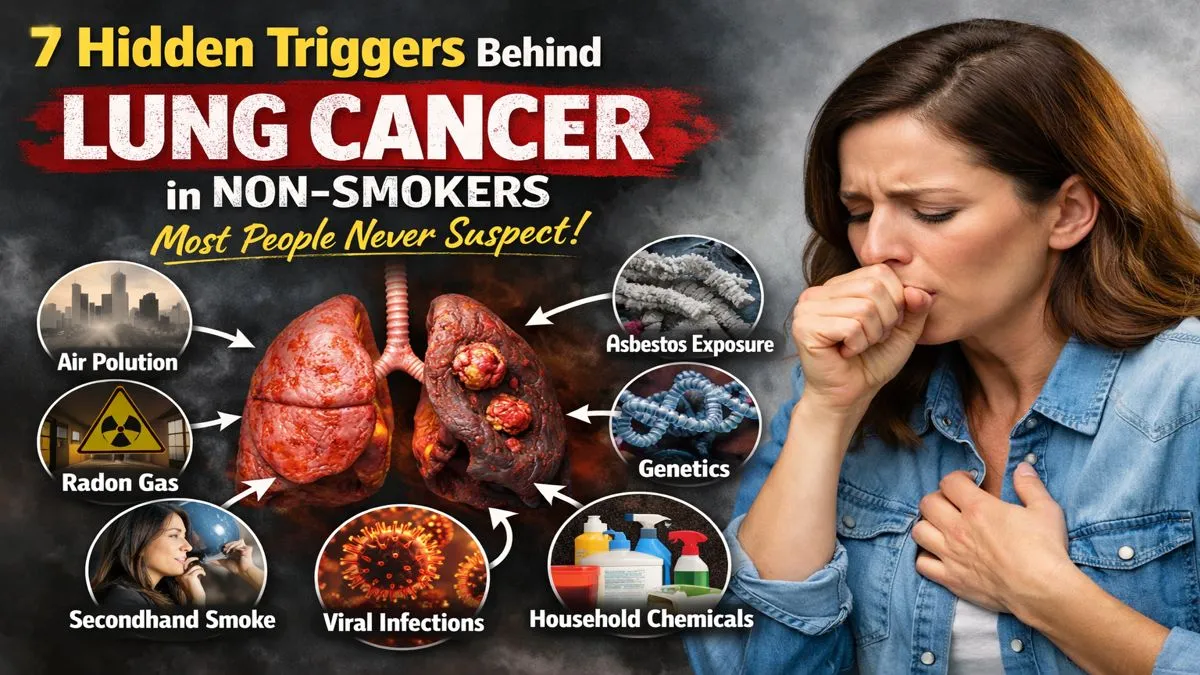
Most people associate lung cancer with cigarettes—but nearly 1 in 5 cases occurs in people who never smoked. This investigative deep-dive uncovers seven overlooked triggers behind lung cancer in non-smokers, from invisible home gases and workplace exposures to genetic switches and everyday pollution. Learn how these risks operate quietly for years—and what you can do now to protect yourself and your family.
7 Hidden Triggers Behind Lung Cancer in Non-Smokers
When doctors first began noticing something strange decades ago, it didn’t make headlines.

Patients walked into clinics with no smoking history, yet scans told a different story. Tumors. Nodules. Silent shadows on lungs that had never touched a cigarette.
Today, researchers estimate that 15–20% of all cases of lung cancer occur in people who never smoked. That’s not rare. That’s a pattern.
So what’s really going on?

After reviewing epidemiological studies, environmental health reports, and interviews with oncologists over the years, a clearer picture emerges. These cancers don’t appear randomly. They follow hidden trails—often inside homes, workplaces, and even family DNA.
Let’s walk through the seven triggers most people never think about.
The Silent Pattern Doctors Began Noticing
Oncology clinics across Asia and North America started reporting something curious: a steady rise in lung cancer among women who had never smoked.

Not secondhand exposure alone. Something deeper.
Environmental science, building design, urban pollution, and genetics began entering the conversation. Slowly, a new understanding formed.
Smoking is the biggest risk factor—but it’s not the only one.
And sometimes it’s not involved at all.
Quick Snapshot: Hidden Triggers at a Glance
| Trigger | Where It Comes From | Risk Level | Prevention Difficulty |
|---|---|---|---|
| Radon gas | Soil beneath homes | High | Moderate |
| Secondhand smoke | Homes, workplaces | High | Moderate |
| Air pollution | Cities, traffic zones | Moderate–High | Hard |
| Cooking fumes | Poor kitchen ventilation | Moderate | Easy |
| Workplace toxins | Industry exposure | Moderate–High | Moderate |
| Genetic mutations | Family biology | Variable | Hard |
| Prior lung disease | Inflammation history | Moderate | Moderate |
Key takeaway: Many triggers build risk slowly over years—not overnight.
1. Radon Gas: The Invisible Intruder Under Your Floor
Radon doesn’t smell. Doesn’t sting your eyes. Doesn’t make noise.
It seeps upward from soil and rock beneath buildings and settles quietly indoors.
Over time, it releases radioactive particles that damage lung tissue cell by cell. No warning signs. No coughing fits. Just silent exposure.
In the United States and parts of Europe, radon is considered the leading cause of lung cancer among non-smokers.
What surprises most homeowners is this:
Modern airtight homes can trap radon more efficiently than older ones.
Testing kits are inexpensive. Yet very few households ever check.
It’s one of the easiest risks to detect—and one of the most ignored.
2. Secondhand Smoke: Exposure That Lingers Longer Than People Think
Many people assume secondhand smoke matters only during direct exposure.
Science disagrees.
Tobacco toxins settle into carpets, curtains, upholstery—even wall paint. This residue is sometimes called “third-hand smoke,” and it can remain active for months.
Children growing up in smoking households face especially elevated risk later in life.
Even adults exposed at workplaces decades ago still show measurable lung damage patterns in imaging studies today.
You don’t have to smoke to carry the consequences.
3. Outdoor Air Pollution: The Risk You Breathe Every Commute
Urban air looks harmless most days.
But fine particulate matter—especially PM2.5—slides deep into lung tissue where it triggers inflammation that doesn’t easily heal.
Cities with dense traffic corridors show consistently higher lung cancer rates among non-smokers.
What makes this risk frustrating is its invisibility.
You can’t opt out of breathing your surroundings.
Still, researchers now rank long-term air pollution exposure as one of the fastest-growing contributors to lung cancer worldwide.
Especially in rapidly expanding metro regions.
4. Cooking Smoke in Poorly Ventilated Kitchens
This one surprises almost everyone.
Traditional cooking methods—especially frying, charcoal cooking, and high-heat oil preparation—release carcinogenic particles indoors.
Studies across South Asia and East Asia repeatedly show elevated lung cancer risk among people who cook daily in enclosed kitchens without ventilation systems.
The pattern appears strongest in households using:
- Biomass fuels
- Coal
- Reused cooking oils
- Deep frying at high temperature
Installing proper exhaust ventilation reduces exposure dramatically.
It’s a simple upgrade with powerful health impact.
5. Workplace Chemical Exposure Most Employees Never Notice
Certain professions carry invisible respiratory risks.
Workers exposed to asbestos, diesel exhaust, arsenic, silica dust, or industrial solvents face increased cancer risk—even decades after exposure ends.
Construction workers. Textile workers. Mechanics. Miners. Factory staff.
Many don’t learn the connection until retirement age screenings uncover abnormalities.
The troubling part?
Symptoms rarely appear early enough to act quickly.
Protective equipment helps—but only when used consistently.
6. Genetic Mutations That Flip the Switch Without Warning
Some lung cancers behave differently from smoking-related cases.
Doctors call them “driver mutation cancers.”
Instead of toxin accumulation over decades, a small DNA alteration suddenly tells lung cells to multiply faster than they should.
Common mutations linked to non-smoker lung cancer include:
- EGFR mutations
- ALK rearrangements
- ROS1 gene alterations
These are more frequently seen in younger patients and women who never smoked.
Here’s the hopeful part.
Modern targeted therapies now treat many of these mutations with remarkable precision compared to older chemotherapy approaches.
Genetics isn’t destiny anymore—it’s information doctors can act on.
7. Chronic Lung Inflammation from Past Illness
Sometimes the story begins years earlier.
Tuberculosis. Severe pneumonia. Long-term asthma complications. Repeated respiratory infections.
Each leaves behind tiny scars inside lung tissue.
Most heal without consequence. Some don’t.
Persistent inflammation creates an environment where abnormal cells can slowly develop.
It’s less dramatic than toxin exposure—but still significant.
Especially in regions where respiratory infections remain common.
Early Warning Signs Non-Smokers Often Ignore
Because smoking isn’t part of the picture, symptoms get dismissed longer than they should.
Watch for:
- Persistent cough lasting weeks
- Chest discomfort without explanation
- Breathlessness during routine activity
- Unexplained fatigue
- Repeated respiratory infections
Early detection changes survival outcomes dramatically.
Never assume “I don’t smoke” equals “I’m not at risk.”
How Risk Builds Quietly Over Time
One exposure rarely causes cancer alone.
Instead, risks layer gradually:
Urban pollution + poor ventilation + genetic sensitivity
Workplace exposure + childhood smoke exposure
Radon + chronic lung inflammation
It’s the combination effect that matters most.
Think of risk like rainfall filling a reservoir.
Each drop seems small. The total eventually matters.
Practical Protection Steps That Actually Work
Some risks feel overwhelming. Others are surprisingly manageable.
You can:
Test your home for radon
Improve kitchen ventilation
Avoid indoor smoke exposure
Use masks in heavy pollution zones
Request occupational safety monitoring if applicable
None eliminate risk completely.
But together, they shift the odds.
And in public health, shifting odds saves lives.
Final Verdict: The Risk Story Most People Never Hear
For decades, lung cancer carried a simple narrative.
Smoke causes cancer.
That story helped millions quit tobacco. It still matters.
But it also hid something important.
Non-smokers were getting sick too—and quietly wondering why.
The truth is less dramatic than headlines yet more unsettling.
Modern living environments, genetics, indoor air quality, and occupational exposure all shape lung health long before symptoms appear.
My personal takeaway after years covering environmental health investigations is this:
The most dangerous risks are usually the invisible ones people never think to check.
Testing your home. Improving airflow. Asking questions about workplace exposure. Paying attention to persistent symptoms.
These are small actions.
Yet they change outcomes in ways statistics rarely capture.
Sometimes prevention begins with simply noticing what everyone else overlooks.
FAQs
Q1. Can non-smokers really get lung cancer without secondhand smoke exposure?
Yes. Triggers like radon gas, air pollution, genetic mutations, and indoor cooking fumes can independently increase risk over time.
Q2. Is lung cancer in non-smokers detected later than in smokers?
Often yes, because symptoms are overlooked longer since people assume they’re not at risk. Early screening awareness helps change outcomes.
Q3. Are women more affected by lung cancer despite never smoking?
Research shows higher rates among non-smoking women, especially linked to genetic mutations and indoor air exposures.
Q4. What’s the simplest step non-smokers can take to lower their risk today?
Start with home radon testing and improving kitchen ventilation—two practical changes that significantly reduce hidden exposure.