
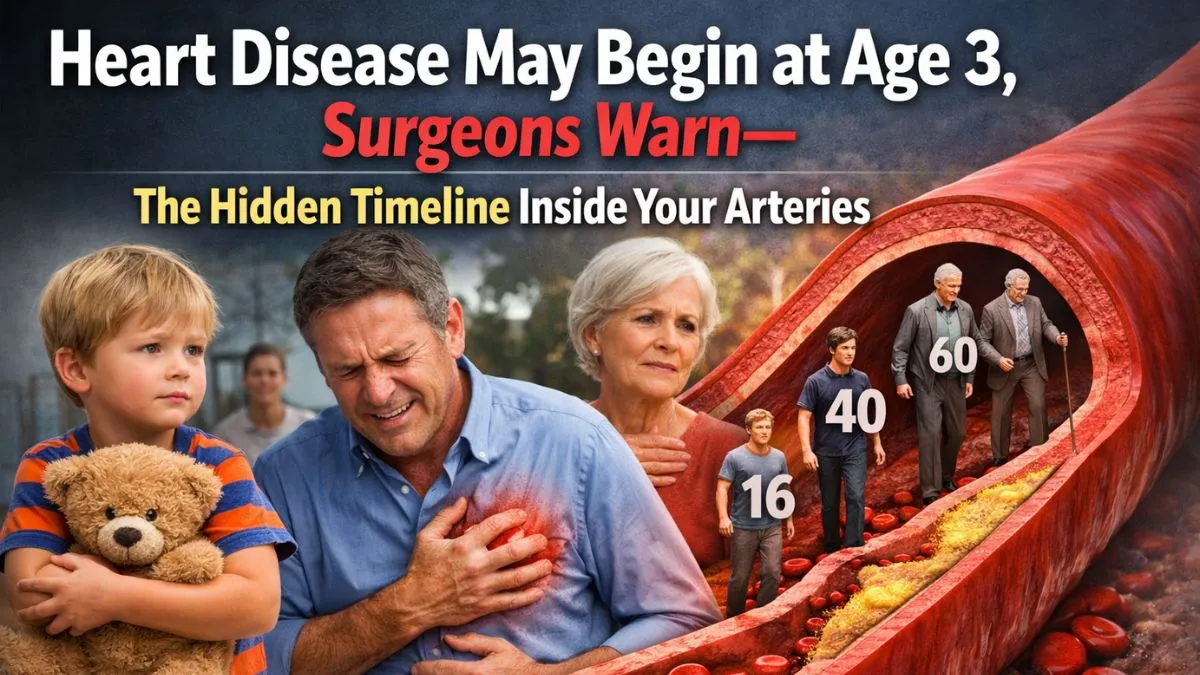
There’s a moment many cardiologists quietly agree on. It usually happens when they hold a patient’s angiogram and see arteries narrowed far earlier than expected. The surprise isn’t the blockage itself. It’s the timeline.
Because heart disease rarely begins the day symptoms appear.

A growing body of research shows the earliest artery changes linked to heart disease can start in early childhood—sometimes around age three. Not chest pain. Not breathlessness. Just microscopic streaks of fat quietly settling inside artery walls like dust that never quite gets wiped away.
That realization changes everything about how we think of prevention.
This isn’t a disease that suddenly arrives. It’s a process that quietly grows alongside us.
The Misunderstanding That Keeps People Unprepared

Ask ten adults when heart disease starts. Most will say their 40s. Some will say after retirement. A few will say “when stress begins.”
Science tells a different story.
The earliest stage of atherosclerosis—the artery-narrowing process behind most heart attacks—can begin in childhood long before symptoms exist.

That’s why surgeons often repeat a simple but unsettling line:
Heart disease isn’t something we suddenly develop. It’s something we slowly build.
Think of arteries like flexible garden hoses. Early in life they’re smooth and wide. Over time, tiny deposits collect along the inner lining. They don’t block water immediately. They just sit there. Waiting.
What Actually Happens Inside a Child’s Arteries
Scientists call the earliest change a fatty streak. It sounds harmless. It usually is at first.
But it’s also the first chapter of a long story.
These streaks are clusters of cholesterol-filled cells forming quietly inside artery walls. Studies have found them present in children—even infants—and becoming more common by early childhood.
Most never notice them. Doctors rarely test for them. Yet they matter.
Because over decades, some streaks evolve into plaques. Plaques stiffen arteries. Stiff arteries struggle to deliver oxygen efficiently.
That’s when heart disease becomes visible.
Why Age 3 Matters More Than It Sounds
The number isn’t random.
Autopsy-based cardiovascular research has shown early fatty streaks can appear by about age three in some children.
It doesn’t mean toddlers are having heart attacks. It means the biological groundwork can begin astonishingly early.
And once that groundwork exists, lifestyle choices either slow it—or accelerate it.
A helpful way to picture this:
Heart disease behaves less like an infection and more like a long financial investment. Every habit adds interest.
A Quick Reality Check: Early Changes vs. Actual Disease
Let’s clear a common fear before it spreads.
Early artery changes are not the same as clinical heart disease.
Here’s the difference that cardiologists emphasize:
| Stage | What’s Happening | Symptoms | Reversible? |
|---|---|---|---|
| Early childhood fatty streaks | Microscopic lipid deposits form | None | Often yes |
| Adolescence progression | Plaques may begin forming | Rare | Sometimes |
| Early adulthood narrowing | Blood flow may reduce | Occasional | Harder |
| Later adulthood blockage | Major artery obstruction | Common | Limited |
Key takeaway: Early detection equals early control.
And early control changes outcomes dramatically.
The Risk Factors That Start Earlier Than Most Parents Expect
Children don’t develop artery damage randomly.
Researchers consistently see the same drivers appear again and again:
Diet patterns high in processed fats
Ultra-processed snacks reshape cholesterol patterns earlier than expected. Childhood nutrition influences artery health decades later.
Physical inactivity
Movement keeps artery walls flexible. Sedentary routines do the opposite.
Passive smoke exposure
Even second-hand smoke increases inflammation linked to early artery changes.
Childhood obesity
Higher body weight correlates strongly with early vascular thickening.
Family history
Children with relatives who had early heart attacks carry elevated lifetime risk.
None of these guarantees disease.
Together, they shape probability.
The Hidden Influence Before Birth Even Happens
One of the most surprising discoveries in cardiology is this:
Heart disease risk can begin before a child is born.
Researchers have identified links between maternal cholesterol levels during pregnancy and early artery changes in offspring.
That shifts prevention even earlier than childhood.
It turns heart health into something families build—not individuals fix later.
Why Symptoms Stay Silent for Decades
Here’s the tricky part.
Arteries don’t complain early.
They stretch. Adapt. Compensate.
That’s why most people first learn about heart disease during a stress test, scan, or emergency room visit—not during routine childhood checkups.
Cardiologists often describe artery disease as a “quiet architect.”
It reshapes structure slowly enough that the body adjusts until it suddenly can’t.
What Cardiologists Wish Families Knew Sooner
Heart surgeons rarely talk in dramatic language unless something matters deeply.
When they say prevention begins in childhood, they mean everyday habits—not medication—shape the biggest outcomes.
These are the protective patterns with the strongest evidence:
Active play beats structured workouts
Running outside matters more than gym memberships.
Whole foods beat “low-fat” labels
Marketing terms rarely equal metabolic protection.
Sleep stabilizes heart chemistry
Children who sleep well regulate blood pressure earlier.
Screen time quietly reshapes circulation habits
Movement interruptions change artery behavior long-term.
None of these require perfection.
They require consistency.
The Surprising Truth About “Inherited Heart Disease”
Many families assume genetics decide everything.
They don’t.
Genetics loads the gun. Lifestyle often pulls the trigger.
Studies show the severity of early artery lesions increases sharply when multiple risk factors combine—especially cholesterol imbalance, obesity, and high blood pressure.
That means prevention works.
And it works earlier than most people realize.
Signs Parents and Adults Should Never Ignore Later in Life
Even though early artery changes stay silent, warning signs eventually appear:
- Unexplained fatigue during routine activity
- Breathlessness earlier than expected
- Chest tightness during stress or exertion
- Persistent high blood pressure
- Abnormal cholesterol readings
These aren’t dramatic symptoms.
They’re early negotiation signals from the cardiovascular system.
The Biggest Prevention Window Most People Miss
The most powerful time to protect the heart isn’t after diagnosis.
It’s before adolescence.
Because fatty streaks remain flexible early on, lifestyle shifts during childhood can reduce long-term plaque formation risk significantly.
That’s the window cardiologists wish more families understood existed.
Once plaques mature, prevention becomes management.
Before that, prevention becomes opportunity.
Final Verdict: The Heart’s Timeline Starts Earlier Than We Were Taught
Here’s the truth that changes perspective.
Heart disease rarely begins when symptoms appear. It begins quietly. Gradually. Sometimes before school begins.
That doesn’t make the future frightening.
It makes it adjustable.
The earlier the timeline starts, the earlier protection can start too.
Think of heart health less like emergency repair and more like long-term construction.
Every walk counts. Every meal counts. Every habit counts.
And the strongest prevention strategy isn’t complicated medicine.
It’s time.